
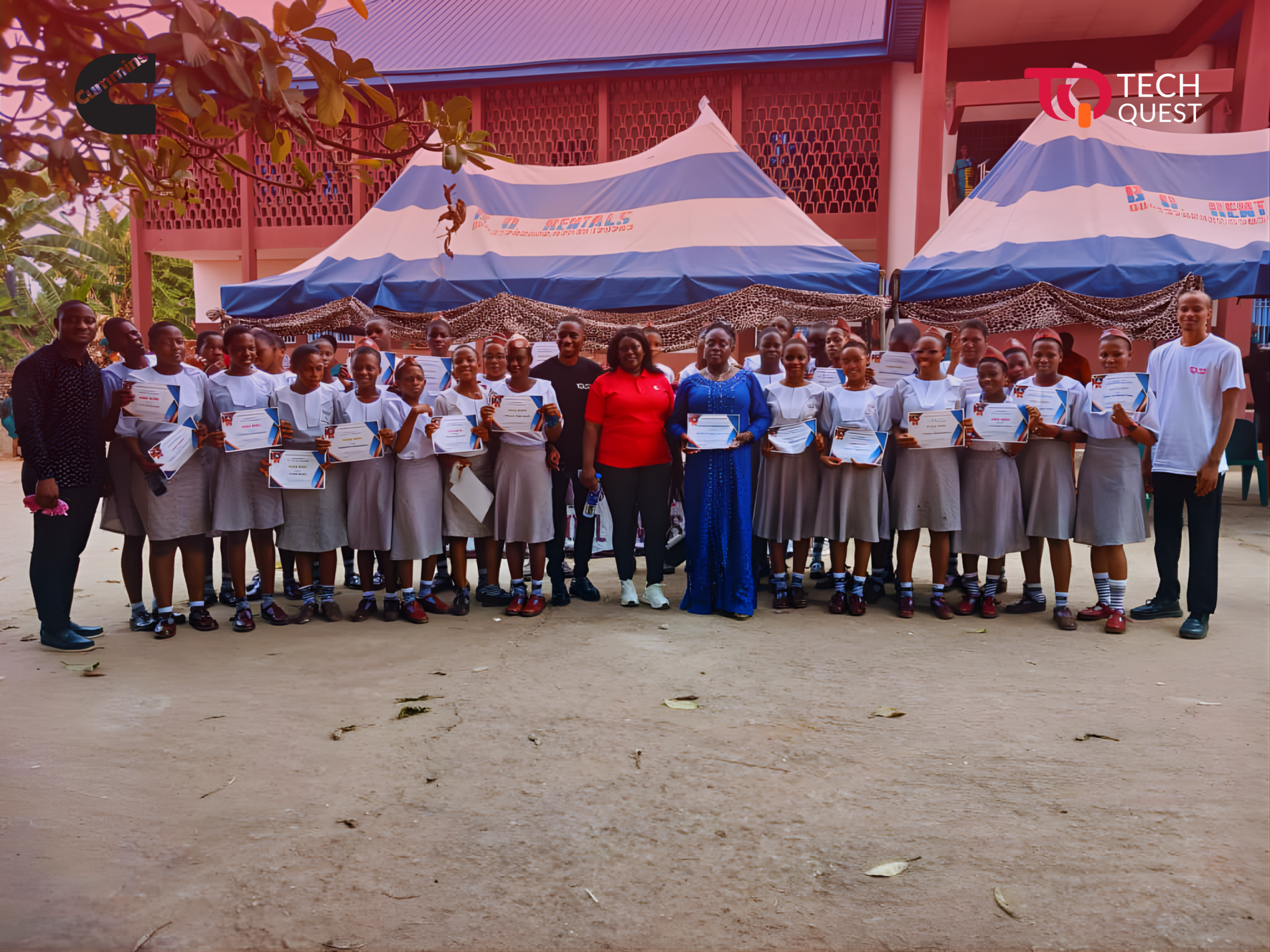
Something remarkable happened quietly at Ado Girls Secondary School in Onitsha, Anambra State. A group of secondary school girls, some barely two months into a digital skills programme, went up against student teams from the United States, the United Kingdom, China, and Russia in a global AI competition. And they won.
The International AI Youth Education Society, which ran its AI Youth Competition between December 2025 and February 2026, named Ado Girls the winner of its Outstanding Organisation Award. It’s the kind of result that makes you stop and think about what “access” really means.
The Programme Behind the Win
The students are part of the Digital Access Programme, a partnership between TechQuest STEM Academy and Cummins Inc. Currently serving 750 students and 10 teachers across the school, the programme provides foundational and emerging digital skills training, the kind that used to be reserved for schools in wealthier parts of the world.
What stands out isn’t just the award. It’s the timeline. The girls had joined the programme barely two months before the competition. That’s not a fluke. It’s a signal.
What It Means
Charles Emembolu, Co-Founder of TechQuest STEM Academy, put it plainly: this isn’t just a win for one school. It’s proof of what’s possible at scale. “When we provide the right infrastructure, curriculum and support, our young people can deliver outcomes that meet global standards,” he said.
Ify Anene, Cummins’ Corporate Responsibility Leader for Africa and the Middle East, framed it around access. The real story here isn’t competition. It’s what happens when girls who have historically been on the wrong side of the digital divide are handed the same tools and mentorship as anyone else.
Anambra State’s Head of Service, Barr. Ngozi Iwouno, was equally clear-eyed about the significance: these students competed creditably against teams from some of the most technologically advanced nations on earth, and they distinguished themselves with multiple international recognitions.
Beyond the Trophy
The award was first presented virtually, then celebrated at the school’s Career Fair Day, where students showcased their projects in front of school authorities, Cummins representatives, and the TechQuest team. A fitting moment and public proof of work that had already made global noise.
But the organisers are quick to point out that the Digital Access Programme was never really about winning trophies. The longer game is teacher development, integrating digital learning into school systems, and building pathways into advanced tech careers. Competitions are just a visible byproduct of that deeper work.
Why This Matters for Nigeria
Nigeria has a digital divide, and within that divide, girls are disproportionately affected. Stories like this one matter not because they’re exceptions, but because they model what it looks like when the exception becomes the rule.
The girls of Ado Girls Secondary School didn’t win in spite of where they’re from. They won because of what they were given: structure, support, and the chance to show up.
That’s a repeatable formula. And TechQuest says they’re already planning to scale it.